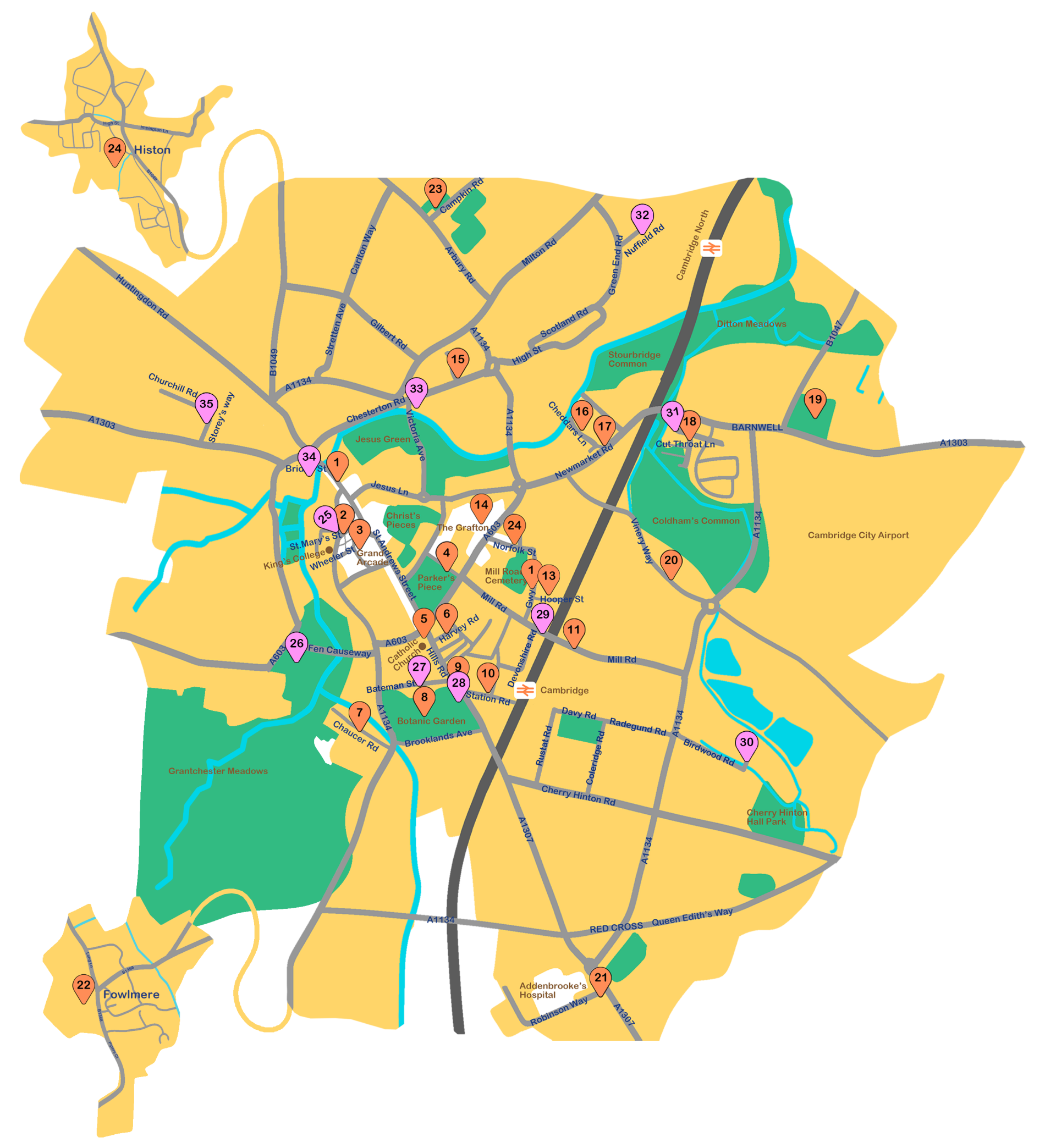
Note: Locations in orange (1-24) are also represented on the paper leaflets for adults and children. Locations in pink (25-35) are additional locations, which are not on the paper leaflets.
Locations on paper map (1-24)

1. Bridge Street
The Cambridge Basque Refugee Committee had a shop near Magdalene Bridge to raise funds for the refugee children from the Basque region in Spain, who had fled the Spanish Civil War in 1937.
2. Great St Mary’s Church
Great St Mary’s Church encouraged members to befriend newly arrived refugees from Vietnam (so-called 'boat people') in the 1970s.

3. Guildhall
Many refugee groups, including those from Chile, met here for folk dances and parties (1970s).

4. Parkside
25 Parkside (owned by Peterhouse College) became a hostel for teenagers from the Kindertransport (1940-45), who had escaped Nazi Germany and other Nazi-occupied countries in 1938/9. A blue plaque marks their history.
5. St Albans Hall (part of the Catholic Church)
The Hall was the main place to socialise for the post-war Polish community (former members of the Polish military, who fought with the British in the Second World War).
6. Harvey Road
A large house in Harvey Road was donated by Cambridge University to accommodate refugees from Chile.

7. Chaucer Road
In the 1930s and 40s, two prominent members of the Cambridge Refugee Committee lived here. In the 1990s, a large hostel for refugees from war-torn Bosnia was established in the road.
8. Cambridge University Botanic Garden
The Botanic Garden became a happy meeting place for Chilean refugees to have picnics and practise their folk dancing.

9. Hills Road, no. 55
Here was the HQ of the Cambridge Refugee Committee (1939-1947) with offices, a canteen and a social centre, where Jewish refugees could meet.

10. Station Road, Salisbury Villas
Salisbury Villas became a hostel for 29 refugee children from the Basque region. They lived here with their chaperones in 1938/9. A blue plaque marks their history.

11. Polish shop on Mill Road
The Polish community started to live around Mill Road, and the Polish shop (does no longer exist), became a key location for their groceries and a taste ‘of home’ (1950s)

12. Hooper Street
A house in this street became a hostel for Vietnamese 'boat people'. This was a first place to stay for many families arriving in Cambridge (1970s).

13. Norfolk Street
Alex Wood Hall in Norfolk Street (HQ of the Cambridge Labour Party) gave a reception to the newly arrived children from the Basque region (1937).

14. Red Cross charity shop in Burleigh Street
The Red Cross shop provided free clothes and household goods for refugees Bosnia.

15. ‘Polonia’ club at 231 Chesterton Road
The club became the main community centre for the Polish veterans, offering meals, a bar, a flat for the priest, a library and a meeting place (since the 1970s).

16. Pye Factory in Chesterton
Pye Factory in Chesterton (producing scientific instruments, radios, TVs, etc.) provided jobs for many refugees, in particular, veterans from Poland (1950s).

17. Newmarket Road, no. 355
The Bosnian Refugee Action Group had a drop-in centre here, where long-term residents and Bosnians provided support for the community.

18. 'Community Garden’ on Whitehill Road
The community garden was set up in 1997 by volunteers from the Bosnian Refugee Action Group, with the support of Cambridge City Council.

19. Newmarket Road cemetery
Many of the Polish veterans, who fought with the British and Allies in the Second World War, are buried here.

20. Coldham's Lane – Vietnamese community
Once established, the Vietnamese community built a residential home for ageing members, marked by a distinctive Vietnamese gate at its entrance (1970s).

21. Bell School of Languages
The Bell School was outstanding in offering free or subsidised English lessons for refugees (e.g. Chilean, Argentinian, and Vietnamese), and providing a place to stay for a short time.

22. Polish Resettlement Camp in Fowlmere
Former members of the Polish military, who fought with the British in the Second World War, were housed here with their families (1945-1950s).

23. Arbury Community Centre
The centre was the focal point for Chilean and Vietnamese refugees to socialise and practise dances (1970s).

24. Chivers Orchards in Histon
Fruit picking for the Chivers jam company provided steady seasonal jobs, especially for Polish women (1950s).
More locations (25-35)
Please see additional locations (to those on the paper leaflets) below and on the map (in pink).

25. Reverend Sturdy in Gonville and Caius College
The Rev. Sturdy, Dean of the college, was an important supporter of the Chilean refugees arriving in Cambridge (1970s).

26. Lammas Land and Grantchester Meadows
Many parties and barbecues, so-called 'asados', were held here by the newly arrived Chilean refugees (1970s).

27. Flat in Bateman Street
This became an important stopping off place for Chileans arriving in Cambridge, including key figures from politics and culture who opposed Pinochet's dictatorship (1970s).

28. War memorial at corner of Hills Rd/ Station Road
The Polish community met here on commemorative days.

29. Polish butcher at corner of Mill Road/Devonshire Road
The butcher on Mill Road, Mr Fabisch, sent food parcels to his native Poland during communist times.

30. St Bede's Secondary School
As a Catholic school, many of the children from the post-war Polish community studied here.

31. Abbey United football club on Newmarket Road
Joe and Tony Gallego, who had arrived as refugee children from the Basque region, played for Cambridge United in the 1940s/50s.

32. Shirley Primary School in Chesterton
Many Polish refugee children, whose fathers had fought with the British military, were taught at this primary school (post-war Britain).

33. Overstream House on Victoria Bridge
The Vietnamese community had its offices here. It was the hub for many local helpers, who supported Vietnamese refugees with their paper work and other tasks (1970s).

34. Fisher Hall, Cambridge
Refugees from Chile met here to held social events and have rehearsals for their folk dances (1970s/80s).

35. Churchill College
The college welcomed many students who had fled their country, including refugees from Argentina (1970s).